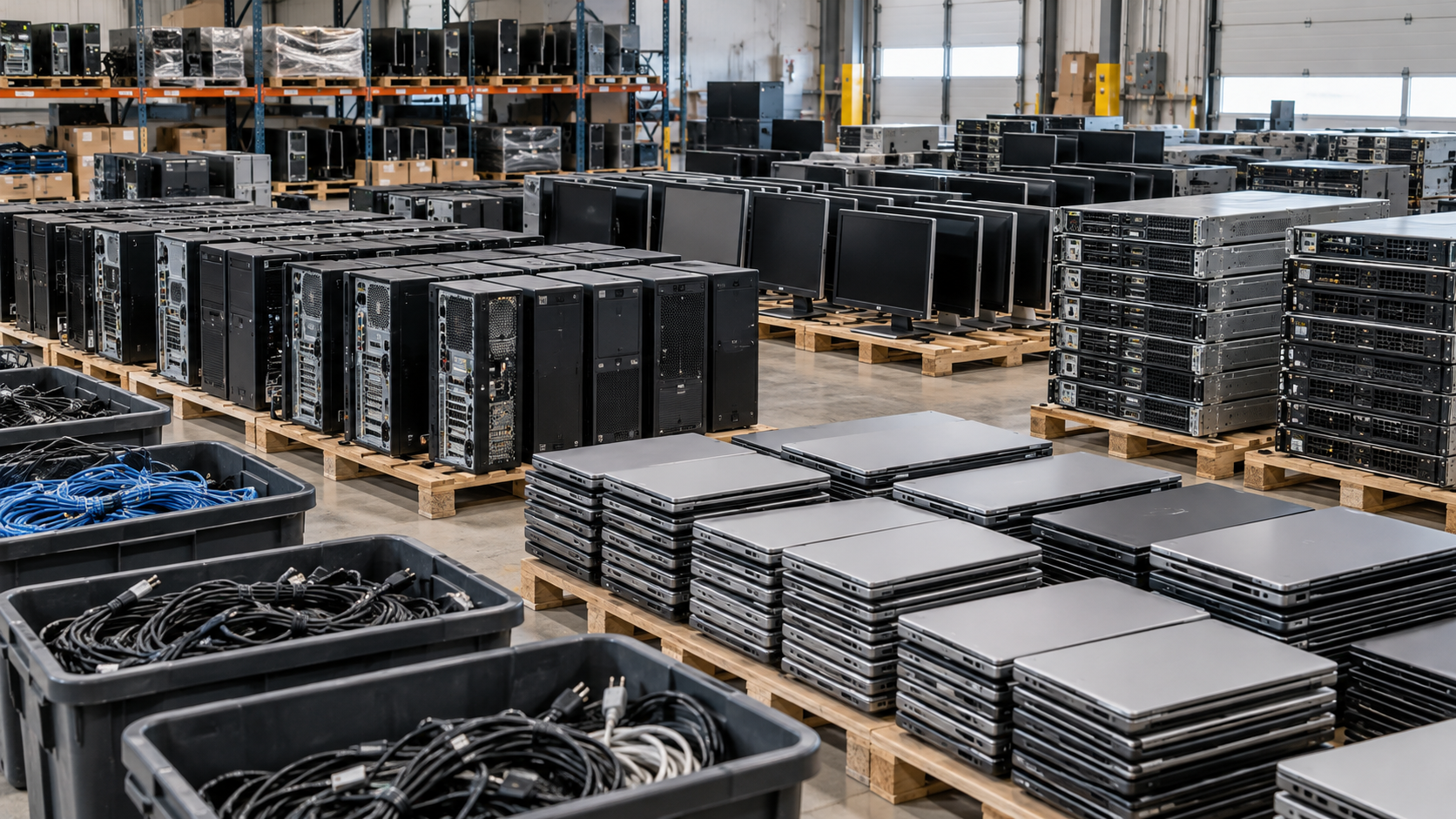
Businesses replace computers, monitors, servers and phones on a regular cycle, and the old equipment has to go somewhere. Commercial electronics recycling is the process of collecting, sorting and responsibly processing that equipment for an organization rather than for a single household. It usually involves larger quantities, data-bearing devices and records that a company may need to keep.
This guide explains what commercial electronics recycling includes, how it differs from consumer recycling, what to prepare, and what to ask a provider before equipment leaves your building.
What Is Commercial Electronics Recycling?
Commercial electronics recycling is a service for businesses, schools, healthcare providers, government offices and other organizations that need to retire electronic equipment. Compared with a household drop-off, it typically includes:
- Volume: pallets of equipment rather than a few items
- Pickup: collection from an office, warehouse or data room
- Data handling: sanitization or destruction of drives in computers, servers and phones
- Reuse evaluation: checking whether working equipment can be resold or reused
- Documentation: inventories, certificates and recycling records
The goal is the same as any responsible recycling program: keep electronics out of the trash and recover usable equipment and materials. The difference is the scale and the accountability a business needs.
Equipment Commonly Included
A commercial electronics recycling project can cover a wide range of equipment:
- desktops, laptops and workstations
- monitors and displays
- servers, storage systems and networking equipment
- printers, copiers and scanners
- phones and tablets
- loose hard drives, SSDs and other media
- cables, keyboards and accessories
- UPS units and battery-containing devices
Some items need special handling. The U.S. EPA notes that CRT funnel glass generally contains enough lead to be regulated as hazardous waste, and batteries can be a fire risk if damaged. Tell your provider in advance if you have CRT monitors, swollen batteries or damaged devices.
How Commercial Electronics Recycling Differs From Consumer Drop-Off
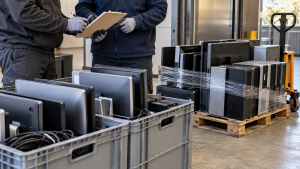
Household collection events and retail drop-off programs are designed for individuals bringing in a few items. Businesses usually need more:
| Consumer drop-off | Commercial service | |
|---|---|---|
| Quantity | A few items | Dozens to thousands of items |
| Logistics | Bring items yourself | Scheduled pickup or bulk delivery |
| Data | Owner wipes devices | Agreed data handling for every device |
| Records | Usually none | Inventory and certificates on request |
| Reuse | Rare | Working equipment may be evaluated for resale |
If your organization has more than a handful of devices, or any devices that stored business data, a commercial service is usually the better fit.
How a Commercial Electronics Recycling Project Works
Most projects follow similar steps:
- Inventory. List equipment by type and approximate quantity, and note which devices contain data.
- Quote and scope. Share the list, pickup location and any data or documentation requirements.
- Data plan. Decide which drives will be wiped for reuse and which will be destroyed. Data Wiping vs Hard Drive Shredding: A Business Guide explains the options.
- Pickup. Equipment is packed and collected, ideally with a signed handoff record.
- Processing. Equipment is sorted, data-bearing devices are handled as agreed, and working items may be evaluated for reuse.
- Reporting. You receive the records you requested, such as an itemized inventory or a certificate of data destruction.
For a step-by-step pickup plan, see Computer Recycling Pickup: A Checklist for Businesses.
Data Security in Commercial Electronics Recycling
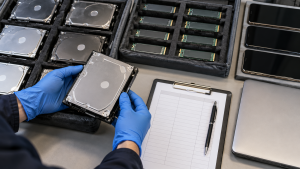
Recycling does not erase data. Laptops, desktops, servers, copiers with storage, phones and loose drives can all hold business information. A responsible commercial electronics recycling plan defines, before pickup, how every data-bearing device will be handled and how the result will be documented.
NIST’s current media sanitization guidance, SP 800-88 Revision 2, encourages organizations to establish a media sanitization program and choose methods based on the sensitivity of their information. Your provider carries out the methods, but the requirements should come from your policies.
Choosing a Commercial Electronics Recycling Provider
When comparing providers, ask:
- Which equipment do you accept, and are there items you do not take?
- Do you offer pickup from our location, and what affects the cost?
- How do you handle hard drives, SSDs and phones?
- Will we receive an itemized inventory and data destruction certificates?
- How is equipment evaluated for reuse, and how is any value handled?
- Which certifications do you hold, and how are downstream partners managed?
The EPA recommends using certified electronics recyclers and names R2 and e-Stewards as the accredited standards. How to Choose an Electronics Recycling Company for Business covers provider selection in more depth.
How 3W Computer Supports Businesses
3W Computer works with organizations retiring IT equipment from its base in Upland, California. On its website, 3W Computer lists e-waste recycling with a zero landfill policy, CRT and LCD monitor disposal, logistics and pickup, detailed inventory reporting, equipment remarketing, and data destruction services including hard drive shredding, software wiping and a certificate of destruction.
Frequently Asked Questions
What is commercial electronics recycling?
It is a recycling service for businesses and organizations that covers collection, data handling, reuse evaluation, recycling and documentation for retired electronic equipment.
Is commercial electronics recycling free?
Sometimes, but not always. Cost depends on equipment type, quantity, location, data handling and any resale value. Ask for a quote based on your inventory.
Do we need to wipe computers before pickup?
Not necessarily, but you need a plan. Either wipe devices internally or agree on how the provider will sanitize or destroy drives, and confirm what records you will receive.
Can businesses use household recycling events?
Many household programs are not designed for business quantities or data requirements. Check the program’s rules before bringing business equipment.
What records should a business keep?
Keep the equipment inventory, pickup or handoff record, data destruction certificates and any recycling or resale reports.
Plan Commercial Electronics Recycling Before Equipment Piles Up
A clear inventory, an agreed data plan and the right records make the process straightforward. Planning ahead also helps you recover value from working equipment and free up storage space sooner.
To discuss commercial electronics recycling for your business, contact 3W Computer with your equipment list and pickup location.
Sources
- U.S. EPA, Electronics Basic Information
- U.S. EPA, Certified Electronics Recyclers
- National Institute of Standards and Technology, SP 800-88 Rev. 2: Guidelines for Media Sanitization
Name: Win Win World Recycle LLC
Address: 1226 West 9th Street, Upland, CA 91786
Phone: 908-798-6789