Certificate of Data Destruction: What Businesses Should Check

Your company hands over 30 retired laptops and receives a document saying the equipment was recycled. Can you use that document to close the data disposal task? Only if it also establishes what happened to the storage, which devices were processed, and how the results were recorded.
A certificate of data destruction can help connect retired equipment with its data handling outcome. Its usefulness depends on the detail behind it. Before booking a service, agree on the records you need, who will review them, and how exceptions will be resolved.
This guide explains what to check, how to compare different disposal documents, and how to reconcile records with your equipment inventory.
What Is a Certificate of Data Destruction?
In business IT disposal, the term generally refers to a record documenting the destruction or sanitization performed on identified data-bearing media. Providers may use names such as certificate of destruction, data erasure report, or certificate of sanitization. Read the recorded action rather than relying on the title.
For example, a record describing data erasure should not be interpreted as proof that the drive was physically destroyed. Equally, a certificate covering specific drives should not automatically be taken to cover every computer collected in the same job.
NIST SP 800-88 Revision 2 recommends documenting sanitization for each information storage medium according to organizational policies. Its Appendix C includes a sample Certificate of Sanitization and allows for electronic records rather than a particular paper format. Source: NIST SP 800-88 Revision 2, Section 4.6 and Appendix C.
A certificate documents work and its reported outcome. Reviewing it is one part of reviewing the overall service, including the agreed method, equipment tracking, and handling of unsuccessful processing.
A Pickup Receipt, Recycling Record, and Data Certificate Serve Different Purposes
Businesses often receive several documents during equipment disposal. Keep their purposes clear so one record does not silently substitute for another.
| Record | What to look for | What to clarify |
|---|---|---|
| Pickup or handover receipt | Equipment transferred, date, parties, and collection reference | Whether counts were provisional or verified |
| Recycling or disposition record | Equipment or material disposition covered by the record | Whether it says anything about storage sanitization |
| Data destruction or sanitization record | Identified media, work performed, outcome, and responsible parties | Whether every expected storage item is accounted for |
A signed collection receipt can establish that equipment changed hands. It does not, by itself, show that data processing has finished.
Likewise, a recycling statement may be relevant to equipment disposition while leaving the data question unanswered. Ask how the records connect: ideally, the collection reference leads to an asset list, and that list leads to the corresponding processing results.
What Should a Certificate of Data Destruction Document?
NIST’s documentation guidance includes media identity, sanitization details, verification information, and responsible individuals. Use that guidance alongside your organization’s requirements when evaluating a proposed reporting format.
Media Identification
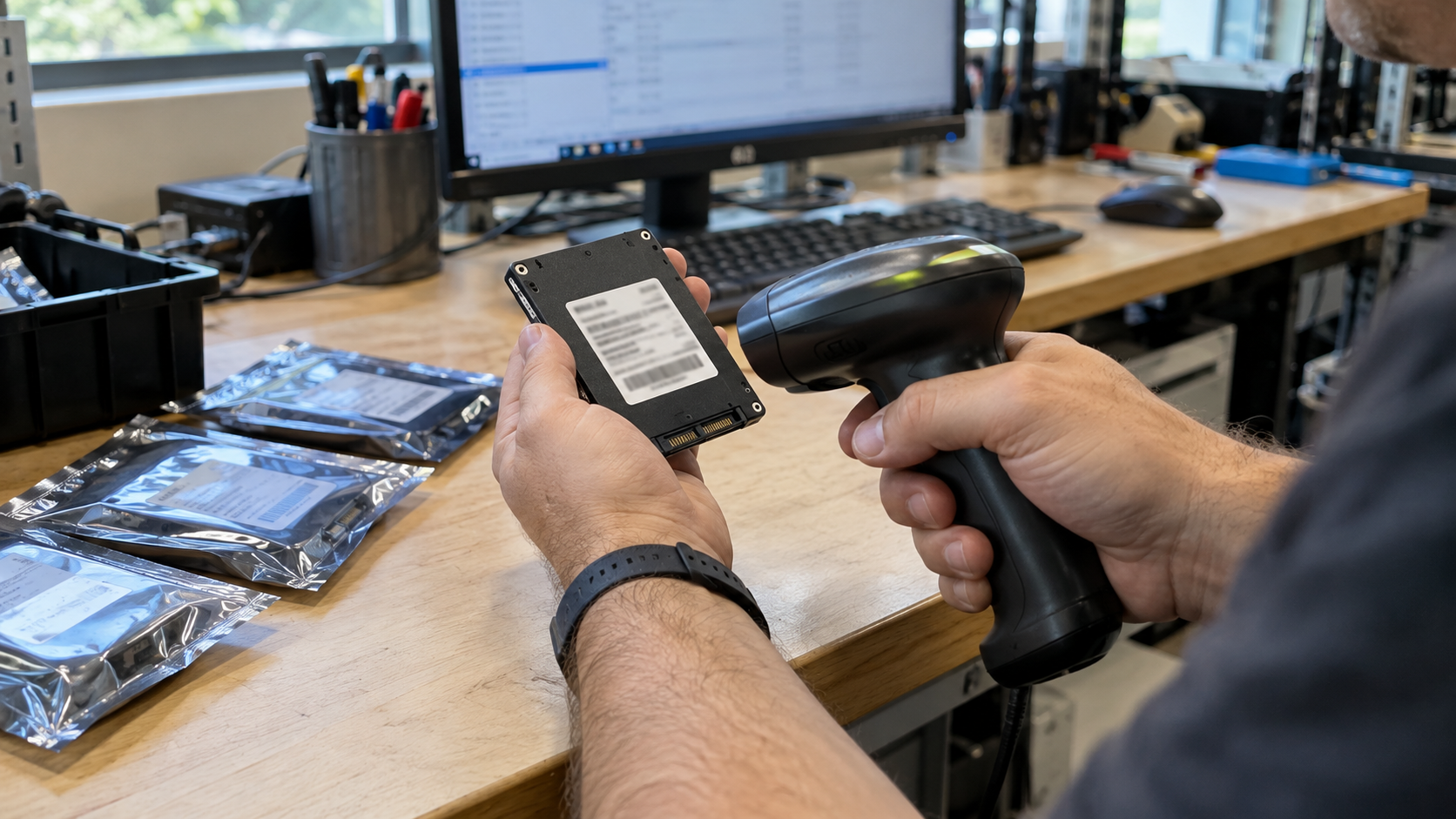
Look for a way to identify the actual storage covered. Relevant fields include manufacturer, model, serial number, media type, and an organizational property identifier when applicable.
A computer asset tag and its internal drive serial number are different identifiers. If the report uses drive serial numbers, ask how those numbers will be connected to the computers in your inventory.
The Work Performed
The record should describe the sanitization method and technique, with the tool and version where applicable. “Processed” is too vague to establish what action was taken.
NIST distinguishes clear, purge, and destroy methods. Those terms should be supported by the recorded technique and the organization’s selected approach, rather than used as unexplained marketing labels.
Results and Responsibility
Review verification and validation information, relevant dates and locations, and the people responsible for the recorded work and review. NIST’s sample form also includes disposition and notes.
Do not assume a completed form means every item succeeded. Ask how failures, unreadable identifiers, or devices awaiting another action are represented. Source: NIST SP 800-88 Revision 2, Sections 4.5–4.6 and Appendix C.
Connect the Report to Your Equipment Inventory
The most practical review starts with the list your business already uses to authorize disposal. Preserve that list and its collection reference, then compare it with the provider’s received-equipment and processing records.
For example, suppose your inventory includes 30 laptops. Two had their drives removed earlier, and one contains two storage devices. A report listing 29 processed drives could be consistent with that situation, but the count alone does not establish it. You need the individual relationships and an explanation for the retained drives.
Record differences explicitly. Useful statuses might include received, processing completed, pending clarification, retained by the customer, or requiring another authorized action. These are suggested internal tracking categories, not a universal reporting standard.
Avoid closing an entire batch simply because its total looks approximately right. A matching total can conceal a missing device and an unexpected extra item.
Ask About Exceptions Before the Job Starts
Unsuccessful processing is easier to manage when the fallback has already been agreed. Ask what happens if a drive cannot be accessed, the selected process fails, or a label cannot be read.
Questions to settle include:
- Who receives the exception notice?
- Will the item remain pending until your business approves another action?
- How is the item identified if its serial number is unavailable?
- Does a fallback action change the price or reporting schedule?
- Will the final record show the actual completed action?
Avoid approving reuse or closing the asset record while a data handling exception remains unresolved. Give a named person in your organization responsibility for reviewing those cases.
For damaged laptops, also establish whether the entire device or only its storage is covered by the agreed work. A report for a removed drive should remain connected to the original computer and to any other storage retained separately.
Review a Sample Report Before Choosing a Provider

Request an anonymized example of the proposed documentation. It helps you evaluate what will be delivered without exposing another customer’s equipment information.
Check whether the example answers your actual questions. Can your IT team match it to an inventory? Does it separate completed results from pending items? Can you export the information into a usable format?
Then confirm the reporting terms in the service arrangement. Ask when records are supplied, whether a serialized attachment is included, who handles corrections, and whether documentation is included in the quoted scope.
For a recurring disposal program, agree on a consistent naming convention and delivery contact. A practical filename might contain the collection reference and date. This makes later retrieval easier than saving every document as “certificate.pdf.”
Is a Certificate Enough to Establish Compliance?
A certificate can support your records, but it does not independently establish that every applicable obligation has been met. Requirements depend on the information involved, your organization, contracts, and relevant rules.
Have the person responsible for your security, privacy, or compliance requirements determine the appropriate process and supporting evidence. Do not assume that one document title is universally mandatory for every US business.
A reference to NIST guidance is also different from a third-party certification of a provider. If a report claims a particular standard or method, ask what work and evidence support that claim. Keep those answers with the approved service scope.
Keep Records Where Your Team Can Find Them
Store the final certificate with its supporting asset list, collection record, exception resolutions, and relevant approvals. Make the connection between these documents visible through a shared job reference.
Restrict access according to your company’s information management practices. Equipment identifiers, site details, and staff contact information may deserve controlled access even when no customer files appear in the report.
Assign an owner for retention and retrieval. The appropriate retention period should come from your organization’s policy and applicable requirements; avoid selecting a number merely because another company uses it.
When a corrected report arrives, keep track of which version was accepted and why. This prevents an incomplete earlier copy from becoming the document someone relies on during a later review.
Frequently Asked Questions
Is a certificate of data destruction the same as a recycling certificate?
They can address different subjects. Read whether the document describes equipment disposition, storage sanitization, or both, and identify exactly which items it covers.
Does the certificate have to be printed?
NIST guidance permits electronic records. Choose a format your organization can retain, search, and connect to the relevant equipment and processing information.
Should every drive have a serial number in the report?
NIST includes serial numbers among its documentation fields. Agree on media identification before the job, including how damaged labels or unavailable identifiers will be handled and mapped to your inventory.
Can one certificate cover several devices?
A summary may be accompanied by itemized records. Confirm that each expected storage item has an identifiable outcome and that the summary and attachment clearly belong to the same job.
Does receiving a certificate mean the provider physically shredded the drives?
Only if that is the action documented for those drives. An erasure or sanitization record may describe a different method. Check the actual technique and outcome.
What should we do if a device is missing from the report?
Keep that item open in your inventory and request clarification. Check the handover list, any removed-storage records, and processing exceptions before accepting a corrected report.
Discuss Documentation Requirements With 3W Computer
Before requesting a certificate of data destruction, identify the equipment involved and the records your organization needs to close the disposal task. Agree on identifiers, completed results, exceptions, and delivery timing before handover.
Contact 3W Computer with your equipment quantities, storage types if known, location, and documentation requirements. Ask what data handling and reporting options are available for your project, and confirm the scope, fees, and supporting records before arranging service.
Name: Win Win World Recycle LLC
Address: 1226 West 9th Street, Upland, CA 91786
Phone: 908-798-6789