
If your business handles customers’ financial information, the GLBA Safeguards Rule may require you to protect that information through a written security program. One part of that program is easy to overlook: what happens to customer information, and the devices that hold it, when you no longer need them. This guide explains the Rule in plain English, with a focus on secure disposal.
This article is general information, not legal advice. Check with your legal or compliance advisor about how the Rule applies to your business.

What Is the GLBA Safeguards Rule?
The Safeguards Rule is the Federal Trade Commission’s Standards for Safeguarding Customer Information, issued under the Gramm-Leach-Bliley Act (GLBA). According to the FTC’s compliance guide, its purpose is to ensure that covered entities maintain safeguards to protect the security of customer information.
The FTC says the Rule took effect in 2003 and was amended in 2021 to keep pace with current technology. It was amended again in 2023 to require covered entities to report certain data breaches, with those notification requirements taking effect in May 2024.
Who Does the GLBA Safeguards Rule Cover?
The Rule applies to financial institutions under the FTC’s jurisdiction that are not subject to another regulator’s enforcement authority under the GLBA. The FTC stresses that “financial institution” is defined more broadly than in everyday conversation, and that what matters is the activities a business undertakes.
The FTC lists examples of covered entities, including mortgage lenders, payday lenders, finance companies, mortgage brokers, account servicers, check cashers, wire transferors, collection agencies, credit counselors and other financial advisors, tax preparation firms, non-federally insured credit unions, investment advisors not required to register with the SEC, and finders. The FTC also notes that some provisions do not apply to institutions that maintain customer information on fewer than five thousand consumers.
What the Rule Requires
The FTC says covered financial institutions must develop, implement and maintain a written information security program with administrative, technical and physical safeguards to protect customer information. Section 314.4 lists nine elements:
- Designate a Qualified Individual to oversee the program.
- Conduct a written risk assessment.
- Design and implement safeguards to control the risks identified.
- Regularly monitor and test the safeguards.
- Train staff.
- Monitor service providers.
- Keep the program current.
- Create a written incident response plan.
- Have the Qualified Individual report to the board or a senior officer.
The Safeguards Rule and Data Disposal
Among the safeguards the FTC describes, two connect directly to retiring equipment.
Know What You Have and Where It Is
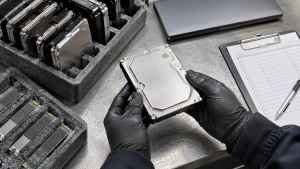
The FTC says businesses should conduct a periodic inventory of data, noting where it is collected, stored or transmitted, and keep an accurate list of all systems, devices, platforms and personnel. That inventory is the foundation of secure disposal: you cannot dispose of data you do not know you have.
Dispose of Customer Information Securely
The FTC states that businesses must securely dispose of customer information no later than two years after its most recent use to serve the customer. The exceptions are a legitimate business need or legal requirement to keep it, or where targeted disposal is not feasible because of how the information is maintained.
Customer information is defined broadly. According to the FTC, it includes any record containing nonpublic personal information about a customer, whether in paper, electronic or other form. That covers files on laptops, desktops, servers and backup drives, and on devices that are easy to forget, such as copiers. Copier Hard Drive Security explains that risk.
Oversee Disposal Vendors

The Rule requires businesses to select service providers able to maintain appropriate safeguards, spell out security expectations in contracts, monitor their work and reassess them periodically. That applies to any company that handles devices containing customer information.
Practical Steps for Retiring Devices Under the Safeguards Rule
- Keep the device inventory current, including serial numbers and where customer data is stored.
- Set retention and disposal rules that reflect the two-year requirement and its exceptions. A written data destruction policy helps.
- Choose sanitization methods by media type. NIST’s SP 800-88 Revision 2 explains how to choose between clear, purge and destroy. See NIST 800-88 Explained.
- Put vendor requirements in writing, including how drives are handled and what records you receive.
- Keep proof, such as a certificate of data destruction tied to serial numbers.
- Report on it. Include disposal practices in the Qualified Individual’s report on the program.
The FTC’s separate Disposal Rule may also apply to information from consumer reports. The FTC says financial institutions subject to both rules should incorporate disposal practices into the security program the Safeguards Rule requires.
How 3W Computer Can Help
3W Computer works with businesses retiring IT equipment from its base in Upland, California. On its website, 3W Computer lists data destruction services including physical hard drive shredding, on-site shredding options, software wiping meeting NIST 800-88 standards and a certificate of destruction, along with detailed inventory reporting and logistics and pickup. Contact 3W Computer to discuss how these services can support your disposal process.
Frequently Asked Questions
What is the GLBA Safeguards Rule?
It is the FTC’s rule requiring covered financial institutions to maintain a written information security program to protect customer information.
Does the GLBA Safeguards Rule require data disposal?
Yes. The FTC says covered businesses must securely dispose of customer information no later than two years after its most recent use to serve the customer, with limited exceptions.
Who must comply with the Safeguards Rule?
Financial institutions under the FTC’s jurisdiction, defined broadly. Examples include mortgage brokers, tax preparation firms, collection agencies and some investment advisors.
Does the Safeguards Rule apply to paper records?
Yes. Customer information includes records in paper, electronic or other form.
Do we need to monitor our disposal vendor?
Yes. The Rule requires businesses to oversee service providers, including through contract terms and periodic reassessment.
Build Secure Disposal Into Your Safeguards Program
The GLBA Safeguards Rule treats disposal as part of protecting customer information, not an afterthought. Know where customer data lives, dispose of it on schedule, choose suitable methods, oversee vendors and keep records.
To discuss secure disposal of retired equipment, contact 3W Computer.
Sources
- Federal Trade Commission, FTC Safeguards Rule: What Your Business Needs to Know
- Federal Trade Commission, Disposing of Consumer Report Information? Rule Tells How
- National Institute of Standards and Technology, SP 800-88 Rev. 2: Guidelines for Media Sanitization
Name: Win Win World Recycle LLC
Address: 1226 West 9th Street, Upland, CA 91786
Phone: 908-798-6789