
California treats discarded electronics more strictly than many states. If your business replaces monitors, laptops or other devices, it helps to understand the basics of e-waste laws in California before old equipment leaves the office. The state runs a recycling program funded by fees paid at purchase, regulates many discarded electronics as hazardous or universal waste, and recently expanded its program to cover products with built-in batteries.
This guide summarizes the main programs in plain language. It is general information, not legal advice. For specific obligations, check the agency sources linked throughout or consult a qualified advisor.

The Electronic Waste Recycling Act of 2003
The foundation of e-waste laws in California is the Electronic Waste Recycling Act of 2003. According to CalRecycle’s Covered Electronic Waste Recycling Program page, the Act established a system for collecting and recycling certain electronic devices. It was created by SB 20, signed on September 25, 2003, and clarified by SB 50 in 2004. The program is implemented by three state agencies: CalRecycle, the Department of Toxic Substances Control (DTSC) and the California Department of Tax and Fee Administration (CDTFA).
Which Devices Are Covered?
The Act focuses on “covered electronic devices.” CalRecycle describes these as video display devices with a screen larger than four inches, measured diagonally, that DTSC identifies as hazardous waste when discarded. Covered categories include:
- CRT televisions and monitors
- LCD televisions, monitors, laptops, tablets, smart displays and portable DVD players (LED devices fall under LCD)
- plasma televisions
- OLED televisions, monitors, laptops and tablets
For many offices, that means most screens, laptops and tablets fall within e-waste laws in California when they are retired.
How the Recycling Fee Works
Instead of charging when a device is thrown away, California collects a recycling fee when a covered device is purchased. Retailers collect the fee at the point of sale. CalRecycle’s fee page lists the current amounts for video display devices:
- more than 4 inches but less than 15 inches: $4
- at least 15 inches but less than 35 inches: $5
- 35 inches or more: $6
Those fees fund payments to approved collectors and recyclers that manage covered devices at end of life.
SB 1215: Battery-Embedded Products
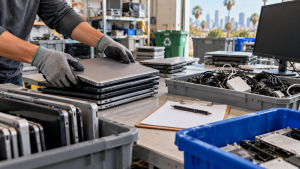
E-waste laws in California expanded with SB 1215, which amends the Electronic Waste Recycling Act to add covered battery-embedded products. According to CalRecycle’s SB 1215 page, a covered battery-embedded product is one that contains a battery not designed to be easily removed by the user. The program aims to reduce battery fires and injuries to sanitation workers.
CalRecycle states that beginning January 1, 2026, consumers pay a recycling fee for these products at the time of purchase. Its covered electronic waste page describes that fee as 1.5% of the retail price, capped at $15. Some products are excluded, including certain medical devices, devices already covered as video displays, certain energy storage systems and electronic nicotine delivery systems.
For businesses, the practical point is that more device types, such as equipment with sealed batteries, now sit inside California’s e-waste system. Loose batteries follow separate rules. Laptop Battery Recycling: Old and Swollen Battery Guide and UPS Battery Recycling: Where to Take Old Battery Backups cover battery handling in more detail.
Universal Waste Rules and the Trash Ban
Beyond the recycling fee program, e-waste laws in California include hazardous and universal waste rules administered by DTSC. DTSC’s universal waste guidance lists electronic waste among California’s universal waste categories and states that universal waste may not be disposed of in the trash, regardless of a business’s exemption status. DTSC’s e-waste page covers which devices are affected and how handlers must manage them.
Part of the concern is what electronics contain. The U.S. EPA notes that CRT funnel glass generally contains enough lead to be regulated as hazardous waste. That is one reason older CRT monitors receive special attention; Computer Monitor Recycling explains how to handle them.
What E-Waste Laws in California Mean for Businesses

Translating the rules into everyday practice, California businesses should generally:
- Keep electronics out of the trash. Treat retired screens, computers and battery-embedded devices as e-waste.
- Use an appropriate collector or recycler. Choose a provider that accepts the specific devices you have. CalRecycle’s eRecycle directory lists local collectors, and the EPA recommends certified electronics recyclers.
- Separate batteries and damaged devices. Swollen or damaged batteries need careful handling and should not be crushed or stored loosely.
- Handle data before devices leave. Recycling rules do not erase data. Plan data sanitization or destruction for laptops, desktops, servers and drives.
- Keep records. Track what left your site, when, and where it went, along with any data destruction certificates.
How to Choose an Electronics Recycling Company for Business lists questions to ask before booking a pickup.
How 3W Computer Helps California Businesses
3W Computer is based in Upland, California, and works with businesses retiring IT equipment. On its website, 3W Computer lists e-waste recycling, CRT and LCD monitor disposal, logistics and pickup, and data destruction services such as hard drive shredding and software wiping. Businesses can contact 3W Computer to discuss which of their devices can be accepted and how data-bearing equipment will be handled.
Frequently Asked Questions
Can businesses throw electronics in the trash in California?
DTSC’s universal waste guidance states that universal waste, which includes e-waste, may not be disposed of in the trash, regardless of exemption status. To follow e-waste laws in California, businesses should use an appropriate collector or recycler.
What devices are covered by California’s e-waste recycling fee?
Video display devices with screens larger than four inches, including CRT, LCD, plasma and OLED TVs and monitors, laptops, tablets and some other displays. Battery-embedded products are covered under SB 1215.
How much is the California e-waste recycling fee?
For video display devices, CalRecycle lists $4, $5 or $6 depending on screen size. For covered battery-embedded products, CalRecycle describes a fee of 1.5% of the retail price, capped at $15.
When did SB 1215 take effect for consumers?
CalRecycle states that consumers began paying the recycling fee for covered battery-embedded products on January 1, 2026.
Do e-waste laws in California require data destruction?
The e-waste programs focus on environmental handling, not data. Data handling is a separate responsibility, so plan sanitization or destruction before devices are collected.
Stay Current With E-Waste Laws in California
E-waste laws in California continue to evolve, as SB 1215 shows. Checking CalRecycle and DTSC guidance before each major disposal project helps keep your business aligned with current requirements, and working with an appropriate recycler makes the process easier to document.
To discuss retiring electronics under e-waste laws in California, contact 3W Computer with your equipment list and pickup location.
Sources
- CalRecycle, Covered Electronic Waste Recycling Program
- CalRecycle, Electronic Waste Recycling Fee
- CalRecycle, SB 1215 Covered Battery-Embedded Products
- California DTSC, Universal Waste Fact Sheet
- U.S. EPA, Electronics Basic Information
- U.S. EPA, Certified Electronics Recyclers
Name: Win Win World Recycle LLC
Address: 1226 West 9th Street, Upland, CA 91786
Phone: 908-798-6789