E-waste figures are quoted everywhere, often without a clear source or year. This guide brings together e-waste statistics from two trusted sources, the United Nations’ Global E-waste Monitor and the U.S. Environmental Protection Agency, and explains what each number does and does not tell you. Every figure below links to where it came from, so you can check it yourself.
Global E-Waste Statistics at a Glance
The fourth Global E-waste Monitor (GEM 2024), published by the International Telecommunication Union (ITU) and the UN Institute for Training and Research (UNITAR), reports:
| Statistic | Figure | Year |
|---|---|---|
| E-waste generated worldwide | 62 million tonnes | 2022 |
| Increase since 2010 | 82% | 2010–2022 |
| Share documented as properly collected and recycled | 22.3% | 2022 |
| Recoverable natural resources unaccounted for | US$62 billion | 2022 |
| Annual growth in e-waste generation | 2.6 million tonnes per year | Trend |
| Projected e-waste generation | 82 million tonnes | 2030 |
| Projected documented collection and recycling rate | 20% | 2030 |
| Share of rare earth element demand met by e-waste recycling | 1% | Current |
What These Global E-Waste Statistics Mean
E-Waste Is Growing Faster Than Recycling
The GEM headline is that e-waste generation is rising five times faster than documented e-waste recycling. Even as recycling grows, the gap keeps widening, which is why the documented recycling rate is projected to fall from 22.3% to 20% by 2030.
The Scale Is Hard to Picture
To make the 62 million tonnes easier to grasp, the report says it would fill 1.55 million 40-tonne trucks, roughly enough to form a bumper-to-bumper line around the equator.
Valuable Materials Are Being Lost
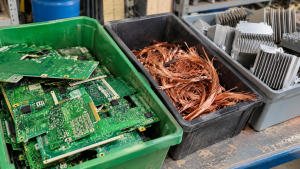
The report estimates US$62 billion worth of recoverable natural resources were unaccounted for in 2022. It also notes that just 1% of rare earth element demand is met by e-waste recycling.
Why the Gap Is Widening
GEM 2024 lists contributing challenges including technological progress, higher consumption, limited repair options, shorter product life cycles, growing electronification, design shortcomings and inadequate e-waste management infrastructure.
Better Recycling Pays Off
The report says that if countries could raise e-waste collection and recycling rates to 60% by 2030, the benefits would exceed costs by more than US$38 billion.
U.S. E-Waste Statistics From the EPA
U.S. figures are less current than the global data. The EPA’s page on cleaning up electronic waste cites an EPA estimate that in 2009, U.S. consumers and businesses discarded televisions, computers, cell phones and hard copy peripherals totaling 2.37 million tons. About 25% of these were collected for recycling, and the rest went mainly to landfills, where precious metals cannot be recovered.
The EPA’s Electronics Donation and Recycling page also cites 2006 U.S. Geological Survey estimates:
- Recycling one million laptops saves the energy equivalent to the electricity used by more than 3,500 U.S. homes in a year.
- For every million cell phones recycled, 35 thousand pounds of copper, 772 pounds of silver, 75 pounds of gold and 33 pounds of palladium can be recovered.
These figures are older, so treat them as illustrations of scale rather than current measurements.
How to Use E-Waste Statistics Responsibly
- Check the year. A 2009 figure and a 2022 figure describe different worlds.
- Check the scope. Global, national and state figures measure different things.
- Check the definition. GEM describes e-waste as any discarded product with a plug or battery. Other sources may count only certain device types.
- “Documented” matters. GEM’s 22.3% refers to e-waste documented as properly collected and recycled, not all recycling that may happen.
- Link to the source. If you quote a statistic, link to where it came from.
What Is E-Waste? explains what counts as e-waste and why it needs special handling.
What E-Waste Statistics Mean for Businesses
The numbers point to a few practical lessons:
- Reuse first. The EPA ranks source reduction and reuse above recycling in its waste management hierarchy. Redeploying or reselling working equipment keeps it out of the waste stream.
- Recycle through accountable channels. Recycling only helps when equipment reaches proper processing. The EPA recommends certified electronics recyclers.
- Protect data along the way. Retired devices often hold sensitive information, so data handling should be part of every recycling project.
- Keep records. Inventory reports and certificates show what you retired and how it was handled.
The E-Waste Recycling Process explains what happens after collection.
How 3W Computer Can Help
3W Computer works with businesses retiring IT equipment from its base in Upland, California. On its website, 3W Computer lists e-waste recycling, equipment remarketing, detailed inventory reporting, logistics and pickup, and data destruction services. Contact 3W Computer to discuss your retired electronics.
Frequently Asked Questions
How much e-waste is generated each year?
According to the Global E-waste Monitor 2024, a record 62 million tonnes of e-waste was generated worldwide in 2022.
What percentage of e-waste is recycled?
The Global E-waste Monitor reports that 22.3% of e-waste generated in 2022 was documented as properly collected and recycled.
How much e-waste will there be by 2030?
The report projects e-waste generation will reach 82 million tonnes by 2030.
What are the latest U.S. e-waste statistics?
The EPA figure cited on its e-waste page is from 2009: 2.37 million tons of selected electronics discarded, with about 25% collected for recycling.
Who publishes the Global E-waste Monitor?
The 2024 edition was published by the International Telecommunication Union and the UN Institute for Training and Research.
Use E-Waste Statistics to Guide Better Decisions
E-waste statistics show a problem growing faster than the systems built to manage it. For businesses, the response is practical: reuse what you can, recycle the rest through accountable channels, protect data and keep records.
To discuss responsible recycling for your retired electronics, contact 3W Computer.
Sources
- ITU and UNITAR, The Global E-waste Monitor 2024
- U.S. EPA, Cleaning Up Electronic Waste (E-Waste)
- U.S. EPA, Electronics Donation and Recycling
- U.S. EPA, Non-Hazardous Materials and Waste Management Hierarchy
- U.S. EPA, Certified Electronics Recyclers
Name: Win Win World Recycle LLC
Address: 1226 West 9th Street, Upland, CA 91786
Phone: 908-798-6789